U Bolts Manufacturer: Commercial vehicles operate under demanding conditions where every suspension component must withstand continuous vibration, heavy loads, uneven roads, and long operating hours. Among these components, U-bolts play a critical role in keeping the axle and leaf spring assembly securely connected. Choosing a reliable U Bolts Manufacturers is therefore important for vehicle manufacturers, fleet operators, spare parts suppliers, and commercial vehicle repair businesses.
High-quality U-bolts contribute directly to vehicle stability, suspension performance, and long-term reliability. Understanding their function and the factors that determine quality can help buyers make better sourcing decisions.
What Are U-Bolts Used For?
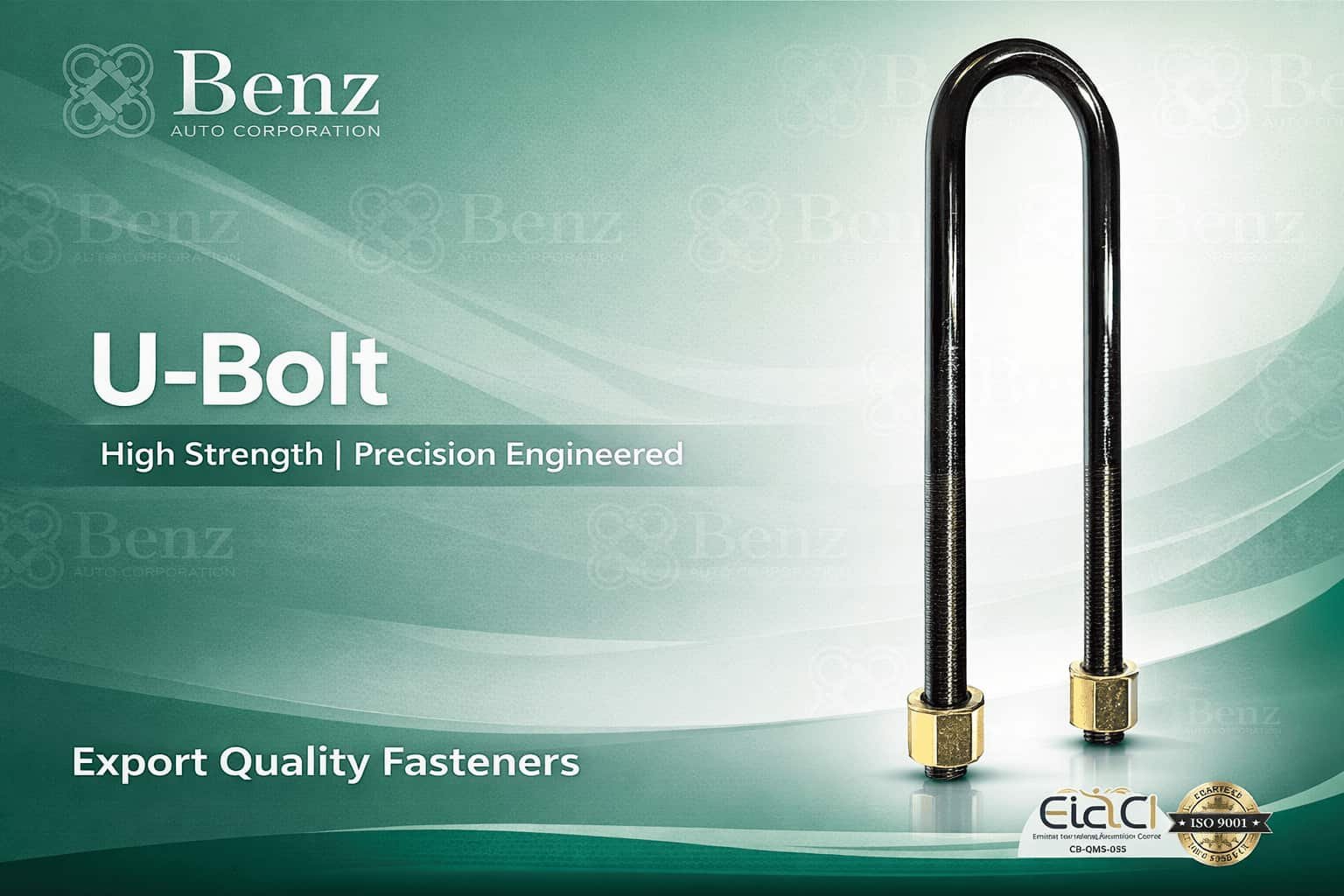
U-bolts are U-shaped threaded fasteners commonly used in leaf spring suspension systems. Their primary function is to clamp the leaf spring pack securely to the vehicle axle.
Commercial vehicles regularly experience vertical movement, vibration, cornering forces, and changes in load. The U-bolts must maintain sufficient clamping force throughout these operating conditions.
They are commonly used in:
- Heavy commercial vehicles
- Trucks
- Trailers
- Buses
- Agricultural vehicles
- Light commercial vehicles
- Special-purpose vehicles
A correctly manufactured U-bolt helps keep the axle properly aligned while reducing unwanted movement within the suspension assembly.
Why U-Bolt Quality Matters
A U-bolt may appear to be a simple component, but its performance depends on several manufacturing factors.
Poor-quality U-bolts can experience thread damage, deformation, corrosion, or loss of clamping force. Such problems may affect the alignment of the axle and suspension system.
For this reason, buyers should select a U Bolts Manufacturer capable of maintaining consistent material quality, dimensions, thread accuracy, and mechanical strength.
Good U-bolts should provide:
- High tensile strength
- Accurate bending
- Reliable threads
- Proper load resistance
- Dimensional consistency
- Good surface finish
- Resistance to corrosion
Consistency becomes especially important for distributors and OEM suppliers purchasing U-bolts in large quantities.
Material Selection Is Important
The durability of a U-bolt begins with the raw material used during manufacturing.
Commercial vehicle applications normally require materials capable of handling repeated stress and significant clamping loads. Manufacturers must carefully select the appropriate grade of steel depending on the vehicle application and required specification.
Material quality directly influences tensile strength, fatigue resistance, and long-term durability.
Heat treatment may also be used to achieve the desired mechanical properties. Proper process control during heat treatment helps ensure that every production batch meets the required strength characteristics.
Accurate Dimensions and Threading
Even a strong U-bolt may perform poorly if its dimensions are inaccurate.
Important dimensions include:
- Rod diameter
- Inside width
- Leg length
- Bend radius
- Thread length
- Thread pitch
The U-bolt must match the axle and suspension configuration correctly.
Thread accuracy is equally important because the nuts must tighten smoothly and maintain the required clamping force.
A professional manufacturer uses controlled tooling, inspection processes, and measurement systems to maintain dimensional accuracy throughout production.
Different U-Bolts for Different Applications
Commercial vehicles do not use one universal U-bolt design.
Different vehicle models may require variations in diameter, width, length, thread specification, and material strength.
A capable manufacturer should therefore be able to produce U-bolts according to customer drawings, OEM specifications, or sample components.
Custom manufacturing is particularly useful for:
- Commercial vehicle manufacturers
- Exporters
- Automotive spare parts wholesalers
- Suspension component distributors
- Replacement parts suppliers
It allows businesses to source vehicle-specific products while maintaining consistent specifications across production batches.
Surface Protection and Finishing
Commercial vehicle suspension components frequently operate in environments exposed to water, mud, road debris, humidity, and temperature changes.
Surface treatment can help protect U-bolts against corrosion and improve their service life.
Depending on the application, manufacturers may use suitable protective coatings or finishing processes.
Buyers should discuss operating conditions with the manufacturer before finalizing the required surface treatment.
What Buyers Should Ask a U-Bolt Manufacturer
Before placing a bulk order, buyers should evaluate more than just the price.
Important questions include:
- What material grades are available?
- Can U-bolts be produced according to drawings?
- What dimensional tolerances are maintained?
- Are customized thread specifications available?
- What quality checks are performed?
- Can the manufacturer handle regular bulk requirements?
- Is proper packaging available for domestic and export orders?
The answers provide a clearer understanding of whether a supplier can support long-term purchasing requirements.
Choosing a Reliable Manufacturing Partner
Commercial vehicle fasteners are safety-critical components, and consistency should always be prioritized over short-term savings.
Working directly with an experienced U Bolts Manufacturer can provide better control over specifications, customization, production quality, and supply consistency.
For businesses sourcing commercial vehicle suspension and fastening components, Benz Auto Corporation offers manufacturing solutions designed for demanding automotive applications. With a focus on accurate dimensions, dependable materials, manufacturing consistency, and customer-specific requirements, the company supports wholesalers, distributors, vehicle component suppliers, and other automotive businesses looking for reliable U-bolt solutions.
Selecting the right U-bolt is not simply about finding a fastener that fits. It is about ensuring that the suspension assembly remains properly secured throughout thousands of kilometres of commercial vehicle operation.