
Walk down almost any suburban street, and you’ll notice the houses that catch your eye. Most people assume it’s the landscaping or paint color doing the work. It usually isn’t. What separates a facade that reads as complete from one that doesn’t is whether the windows have any visual weight to them. A bare window opening is just a hole in a wall. Decorative window shutters change that entirely they frame the opening, give it depth, and make the window feel like it belongs to the house rather than sitting awkwardly within it.
Proportion Gets Ignored Too Often
Most shutter installations that look wrong have one thing in common. The shutter height doesn’t match the window. This sounds obvious, but it’s the mistake that appears most often, usually because shutters are bought in standard sizes and installed without adjusting to the actual opening. The old rule that a shutter, when swung closed, should cover the window completely isn’t decorative theory. It’s why shutters were invented. When that proportion is respected, the eye reads the window and shutter as one unified element. When it isn’t, something feels off, and nobody can quite put their finger on what.
Federation Homes Were Built for This
Australian federation and colonial homes have a natural compatibility with shutters that newer builds don’t automatically share. The window openings are typically tall and well-proportioned; the facades have rhythm and detail, and louvred or panelled shutters slot in without any visual effort. Newer rendered homes are harder. A traditional louvred timber shutter on a contemporary facade tends to look grafted on rather than integral. For those properties, flat-panel or blade-style decorative window shutters work considerably better especially when the finish borrows from materials that already exist somewhere else on the building.
What Shadow Lines Actually Do
Shutters mounted slightly proud of the wall even a few centimeters out create a shadow line that changes how the whole facade reads in different light. Early morning and late afternoon sun catches those edges, and suddenly a flat surface has layers. This isn’t something most shutter guides mention because it’s hard to photograph and easy to miss until you’ve actually seen it on a building. On a rendered wall that has no other surface relief, it’s one of the most effective things you can do to the exterior without changing any of the underlying structure.
Inside, They Outperform Curtains in Specific Ways
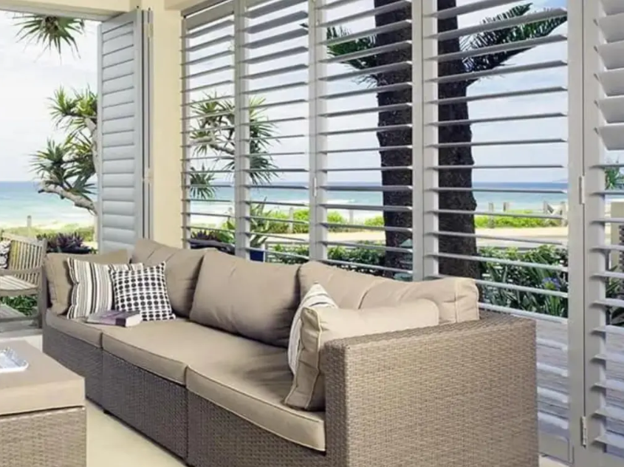
There’s a particular problem that curtains can’t solve well. You want privacy from the street, but you also want natural light in the room. With curtains, it’s usually one or the other. Decorative window shutters fitted internally with adjustable louvres give you a middle position the angle controls how much light enters and from which direction, while still keeping the room private from outside. In older period homes, there’s another reason to consider them. Many Victorian and Edwardian properties originally had internal shutters that were removed during mid-century renovations. Reinstating them is a restoration as much as an upgrade.
Colour Matching Is Almost Always the Wrong Move
The instinct to match shutters to the wall colour seems safe. It isn’t. When the shutter and wall are too close in tone, the shutter vanishes visually, and the facade reads flat again, which defeats the purpose of installing them. The properties where shutters look best are almost always the ones where there’s genuine contrast at work. A charcoal shutter against a pale render. A deep sage green against cream weatherboard. The contrast doesn’t need to be bold or jarring. It just needs to be enough that the shutter registers as a deliberate design element rather than a surface detail.
Conclusion
There’s no single feature that transforms a facade, but shutters come closer than most. The reason they underperform on so many homes isn’t the product itself it’s the decisions made around proportion, style, color, and placement. Decorative window shutters chosen and installed with those things properly considered look like they were always meant to be there. That quality of looking inevitable rather than added-on is exactly what separates a facade that genuinely works from one that almost does.